Tests of robustDIF with item-level information
Peter F Halpin & James Eagle
2026-04-23
Tests of robustDIF with item-level information.RmdDifferential item functioning
In the Item Response Theory (IRT) literature, Differential Item Functioning (DIF) is an approach to assessing situations where response values to an assessment differ as a function of an external covariate; for example, gender or treatment condition. In many contexts, the main goal of DIF analysis is to evaluate whether the items on an assessment are biased in regards to these external covariates. Traditional DIF methods require analysts pre-specify a set of anchor items (items assumed to not have DIF). In the robust DIF method, no such requirement is made. (See technical notes for more details)
The following example demonstrates how to use robustDIF
to investigate DIF across gender in a 5-point Likert-type survey.
Persistence in the Sciences Survey
The Persistence in the Sciences Survey is a validated self-report instrument which measures several social and psychological factors related to undergraduate students’ persistence in attaining STEM degrees (Hanauer et al., 2016). The data used for this example consists of 1024 student responses to the Science Self-Efficacy portion of the survey. These include seven items that ask students how confident they are in performing scientific duties (e.g., “Please indicate the extent to which you agree or disagree about your confidence in the following areas: I am confident that I can use technical science skills.”) Response categories are 1 = “Strongly Disagree”, 2 = “Disagree”, 3 = “Neither Agree nor Disagree”, 4 = “Agree” and 5 = “Strongly Agree.” Administrative data also included self-reported sex, 0 = “Male” and 1 = “Female.”
Calculating multiple group Graded Response Model
The following code utilizes mirt to build graded
response IRT models for future testing of robustDIF:
# Subset data to just items
items <- eg_pits[,c(6:12)]

# Calculate 1-factor 2PL models, using treatment to split groups and specifying SE=TRUE for the covariance matrix.
mirt <- multipleGroup(items,
                      model = 1,
                      group=eg_pits$gender,
                      itemtype = "graded",
                      SE=TRUE)
# Plot the IRFs
itemplot(mirt, item = 1, type = "trace")
itemplot(mirt, item = 5, type = "trace")
Because each item in a GRM has multiple curves, we use
itemplot() of type="trace" for each
item to investigate the category response functions (CRF).
The CRF show how the probability of endorsing each response category
changes as a function of the latent trait.
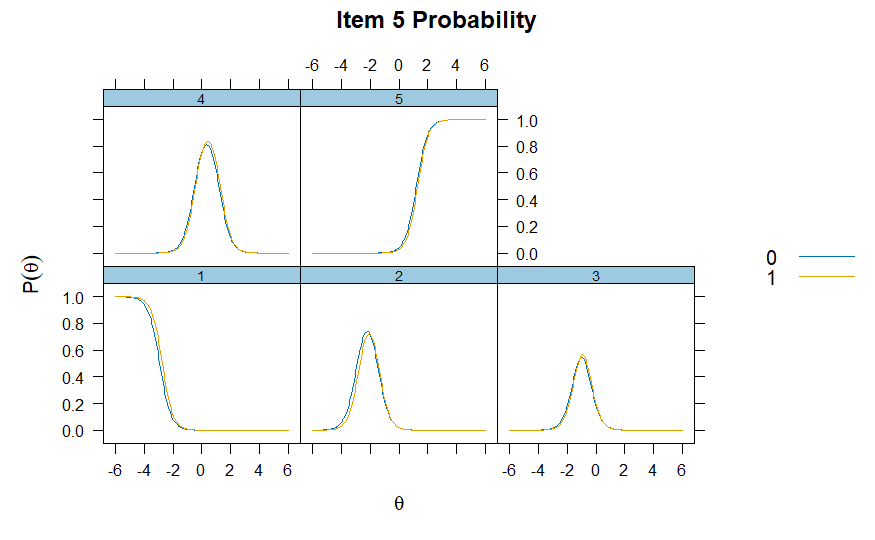
Investigating Item 5, we can see that individuals lower on the latent
trait (self-efficacy) are more likely to respond with lower categories
(“Disagree” and “Slightly Disagree”), with the probability of endorsing
higher categories (“Agree” and “Strongly Agree”) increasing as
self-efficacy increases. Notably, we can also see the CRFs are very
similar between the two groups. (0 = Male, 1 =
Female)
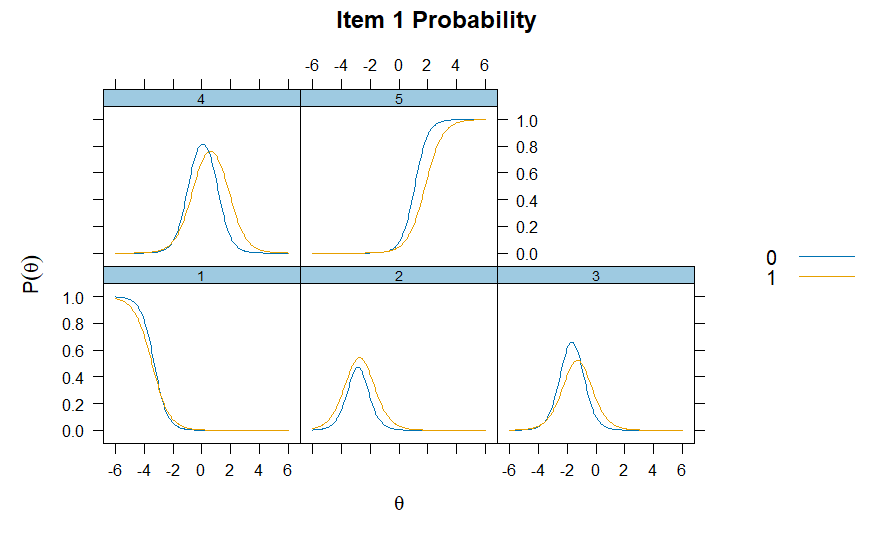 However,
investigating Item 1, we notice the two groups start to differ on their
CRFs. This may indicate potential DIF, or bias, on this item, relevant
to gender.
However,
investigating Item 1, we notice the two groups start to differ on their
CRFs. This may indicate potential DIF, or bias, on this item, relevant
to gender.
The Robust DIF procedure
The get_model_parms() function from
robustDIF can now be used to extract the estimates from the
mirt object. After, robust DIF can be investigated using
the rdif() function. Users supply a significance level by
setting alpha (here, .01) and testing for DIF
on slope (discrimination), intercept (difficulty), or both with
fun. Here, we choose d_fun1 to test for DIF on
intercept/difficulty.
In the GRM, the each item has multiple difficulties, which each
represent the points where adjacent categories intersect in the CRF
(also called the category thresholds). These thresholds
represent the level of the latent trait where a respondent is equally
likely to respond with values below and above that level. Essentially:
the level of the latent trait where respondents transition from a lower
category response to a higher one.
Tests of intercept DIF on GRM thresholds are tests whether, at the same level of the latent trait, one group consistently endorses higher or lower categories.
# Save model parameters
parms <- get_model_parms(mirt)

# Investigate DIF on item intercepts
mod <- rdif(mle = parms, fun = "d_fun1", alpha = .01)
# Print estimate
print(mod)
## Est: -0.1481082 SE: 0.07820133## Robust Scaling and Differential Item Functioning.
##
## Data: 7 items
## Estimation ended after 17 iterations
## Single solution found
##
## Est: -0.148 SE: 0.0782
##
## Results from Wald Tests of DIF:
## delta se z.test p.val
## item1_d1 -0.574381012 0.43879361 -1.30900039 0.19053421757
## item1_d2 -0.747552934 0.21589653 -3.46255187 0.00053507876
## item1_d3 -0.368226017 0.09433800 -3.90326275 0.00009490458
## item1_d4 -0.110625152 0.13700115 -0.80747611 0.41939223383
## item2_d1 0.009736612 0.23223496 0.04192570 0.96655793135
## item2_d2 0.052342625 0.11306929 0.46292521 0.64341797978
## item2_d3 -0.010039471 0.06548194 -0.15331665 0.87814856771
## item2_d4 -0.170708707 0.16692004 -1.02269748 0.30645090211
## item3_d1 -0.465560396 0.30597581 -1.52155947 0.12811949831
## item3_d2 -0.286243087 0.12280276 -2.33091733 0.01975771903
## item3_d3 -0.113514294 0.06313451 -1.79797546 0.07218089628
## item3_d4 -0.103643242 0.17362436 -0.59693954 0.55054774953
## item4_d1 0.451838229 0.40542626 1.11447697 0.26507461950
## item4_d2 0.087585195 0.17055980 0.51351604 0.60759039017
## item4_d3 -0.091670742 0.07233158 -1.26736816 0.20502367990
## item4_d4 -0.736954064 0.19011611 -3.87633680 0.00010604088
## item5_d1 0.102918860 0.38724573 0.26577145 0.79041523056
## item5_d2 0.155037929 0.13629349 1.13752996 0.25531680680
## item5_d3 0.113430425 0.07634573 1.48574681 0.13734610516
## item5_d4 -0.003861489 0.14668103 -0.02632576 0.97899750999
## item6_d1 0.402687606 0.26424079 1.52394191 0.12752322413
## item6_d2 0.147482441 0.11985589 1.23049807 0.21851064945
## item6_d3 -0.057595457 0.07343618 -0.78429270 0.43286837915
## item6_d4 -0.597895432 0.22053201 -2.71115034 0.00670502176
## item7_d1 0.222448538 0.31420560 0.70797127 0.47896310204
## item7_d2 0.112855173 0.14331992 0.78743538 0.43102704308
## item7_d3 0.259627471 0.09062527 2.86484624 0.00417211773
## item7_d4 0.252345911 0.18996651 1.32837048 0.18405574573The print() function provides the scaling parameter
(-0.15) and standard error (0.08) estimated
using iteratively reweighted least squares with Tukey’s bisquare, and
summary() provides additional information regarding Wald
tests on each of the items. Significant p-values indicate that, at the
chosen alpha, the item was flagged for DIF. Those items are
downweighted to zero during estimation of the scaling parameter.
delta is the estimated scaling parameter subtracted from
the item-level scaling function value.
Here, the items that were flagged for DIF were: Item 1
(d2 and d3), Item 4 (d4), Item 6
(d4), Item 7 (d3).